
At the 2021 United Nations Food Systems Summit, governments, development partners and the private sector representatives committed to scaling up financing to national pathways for food systems transformation, moving away from practices that harm people and the planet. It also recognized that in relation to their national economies, the least developed countries bear the heaviest financing burden to meet the costs of food systems transformation. Estimates from the costs of ending hunger to the global cost of transitioning to high-performing food systems vary and range between US$33 billion and US$350 billion per year. No matter which estimate is used, currently nobody knows how much is mobilized to finance the world’s transition to higher-performing food systems. Meeting financial commitments for food systems transformation requires keeping track of financial flows to food systems. Yet, a major knowledge gap facing decision-makers and stakeholders is that there is limited evidence on how countries and the global community are financing food systems transformation. Specifically, the volume and targeting of the financial flows to food systems, gaps and needs are unknown.
The development of the 3FS was co-led by the International Fund for Agricultural Development (IFAD) and the World Bank (WB) in collaboration with the Inter-American Institute for Cooperation on Agriculture (IICA) and the UN Food Systems Coordination Hub, while also leveraging the expertise and instruments of the ecosystems of support1. The 3FS is a response to the lack of evidence on financial flows to food systems. It aims at providing decision-makers and stakeholders with evidence on the scale and scope of financial flows to food systems at country and global levels to inform impactful decisions and foster mutual accountability for transformative financing to food systems.
1 IFAD and the WB consulted with a Strategic Advisory Group composed of experts from the Inter American Institute for Cooperation on Agriculture (IICA); the Global Alliance for Improved Nutrition (GAIN), the Food and Agriculture Organization (FAO); the Organization for Economic Cooperation and Development (OECD); the African Agricultural Transformation Initiative (AATI) in collaboration with the McKinsey & Company, Scaling Up Nutrition (SUN), Sustainably Growing Africa Food Systems (AGRA), AKADEMIYA2063, the Good Food Finance Network (GFFN), and the 4SD foundation.The 3FS offers a harmonized methodology to measure financial flows to food systems. It generates updated information on:
The 3FS builds on the SDG financing strategy2 and tracks three financial flows to food systems:
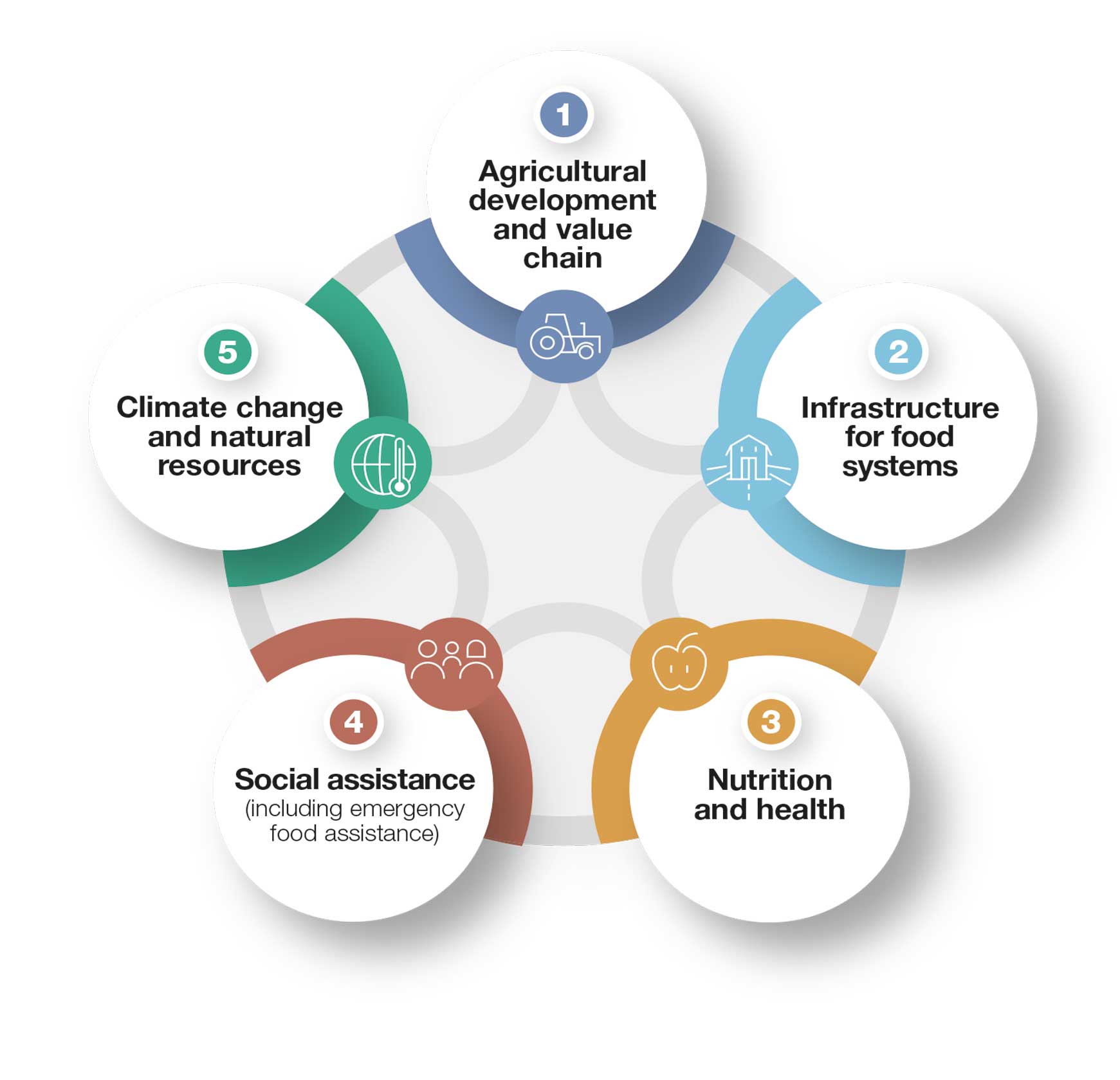
To measure financial flows to food systems, the 3FS aligns with the United Nations High-Level Panel of Experts on Food Security and Nutrition (HLPE) definition on food systems, encompassing various sub-systems and activities related to food production, processing, distribution, and consumption. The 3FS also aligns with the Classification of the Functions of Government (COFOG), the international classification system from the UN Statistics Division (UNSD), that categorizes government expenditure by functions, designed to be applicable universally across countries. By drawing upon the HLPE’s definition of the food system and aligning with COFOG, the 3FS measures financial flows to food systems in a systemic manner across five inter-connected expenditure components for food systems: Agricultural development and value chains, infrastructure for food systems, nutrition and health, social assistance (including emergency food assistance), and climate change and natural resources.
The 3FS five expenditure components underwent thorough validation with a strategic advisory group2 and pilot countries, to ensure their relevance for measuring the financial flows to food systems. For each of these components, the 3FS methodology tracks relevant expenditures to food systems based on leading methodologies, namely:
 2 The 3FS Strategic Advisory Group includes leaders
and experts from the Inter-American Institute for Co-operation on Agriculture (IICA);
the Organization for Economic Co-operation and Development (OECD); The Food and
Agriculture Organization of the United Nations (FAO); The Global Alliance for Improved
Nutrition (GAIN); the African Agricultural Transformation Initiative (AATI) with
expertise from McKinsey and Company; Sustainably Growing Africa's Food Systems (AGRA);
AKADEMIYA2063; the Good Food Finance Network (GFFN), the 4SD Foundation, and the Scaling
Up Nutrition Movement (SUN).
2 The 3FS Strategic Advisory Group includes leaders
and experts from the Inter-American Institute for Co-operation on Agriculture (IICA);
the Organization for Economic Co-operation and Development (OECD); The Food and
Agriculture Organization of the United Nations (FAO); The Global Alliance for Improved
Nutrition (GAIN); the African Agricultural Transformation Initiative (AATI) with
expertise from McKinsey and Company; Sustainably Growing Africa's Food Systems (AGRA);
AKADEMIYA2063; the Good Food Finance Network (GFFN), the 4SD Foundation, and the Scaling
Up Nutrition Movement (SUN).
The 3FS draws on existing and well-established data sources to measure the financial flows to food systems:
To measure financial flows to food systems, the 3FS uses a “tagging approach”. Tagging means systematically analyzing expenditures in national budgets and the CRS database3 to identify those that can be categorized as food system financing. The tagging approach includes the following steps:
To measure the domestic public financing to food systems, the 3FS relies on country ownership. The 3FS brings in a collaborative effort a team of experts from relevant spending ministries and agencies for food systems, and the Ministry of Finance. Together, they undertake the examination of expenditures related to food systems within the national budget and their distribution among the five food systems expenditure components. Country ownership is pivotal for the 3FS methodology to secure the endorsement of results by the country stakeholders and ensuring that those responsible for steering the National Pathway for food systems transformation have had a hand in reviewing that expenditures are aligned with national priorities. For international development financing to food systems, the 3FS data built on a collaboration with the OECD, which provides and supports the interpretation of the CRS data identified as relevant for food systems.
The 3FS design was led by Nadine Gbossa, IFAD; Christopher Brett, World Bank; and Eugenio Díaz-Bonilla, IICA, under the general oversight of IFAD, World Bank, and the UN Food Systems Coordination Hub’s leadership: Martien van Nieuwkoop, World Bank; Satu Santala and Jo Puri, IFAD; and Stefanos Fotiou, UN Food Systems Coordination Hub. The 3FS technical and coordination team consisted of the following: Lucas Lindfors, Miriam Centurion, Clara Picanyol, Cesar Ciappa, Timothée Tabapssi, Devika Saini, Laura Ugarte and Maria Kloss-Corell. At various stages of the process, temporary contributions were provided by Elena Bertusi, Kenyi Cansino Montanez, Armando Cortez Tellez, Jerome Camier, Alessandro Pastore and Andrea Felici. The 3FS team collaborated with OECD on international development financing to food systems: Haje Schütte, Koen Deconinck, Yasmin Ahmad, and Anthony Kiernan. Comments and peer review was provided by Corinna Hawkes and Dalia Mattioni, FAO, and Joshua Levens, SUN Movement. We thank the 3FS Strategic Advisory Group for their guidance: Lawrence Haddad, GAIN; Madhur Gautam and Geeta Sethi, World Bank; Eugenio Díaz-Bonilla, IICA; Ousmane Badiane, AKADEMIYA2063; Safia Boly, AATI; David Laborde and Mohamed Manssouri, FAO; Sara Savastano, IFAD; David Nabarro, 4SD Foundation; and Omid Kassiri from McKinsey & Company and his team. We offer a special note of appreciation to Dr Lawrence Haddad, GAIN, and Dr Agnes Kalibata, AGRA, for their thought leadership and strategic insights. Finally, we thank the interns for their assistance in the development of the 3FS: Sofia Mauceri, Edoardo Castiglioni and Valentina Polacchi. We acknowledge that this list may not include every contributor and apologize for any omission.


Required Citation: IFAD and the World Bank. 2024. 3FS Tracking Financial Flows to Food Systems